Three Overlooked Rock Guitar Performances

Mike Bloomfield, the guitar on the left, and Al Kooper on keyboards, support Bob Dylan at the Newport Folk Festival on July 25, 1965, the fateful day when Dylan went electric. Photo by David Gahr/Getty
Electric guitar powered the emergence of rock ‘n’ roll. Here are three performances that pay tribute to the genre. A playlist of favorite rock guitar recordings follows.
Hey, I get it: Free Bird. Stairway to Heaven. SRV & EVH. Townshend’s windmill. Crazy Train. Eruption. La Grange. Highway Star. Slowhand. Jimi and Jimmy. Power chords.
These songs and faces usually rule your typical rock hobbyist list of favored guitar performances. Rock fans worship at the altar of loud, piercing guitar notes played at a breakneck pace. (Cue Michael J. Fox in Back to the Future.)
We all store snippets of rock guitar in the back of our minds, which we can recall for instant gratification. Admit it: Your air guitar pantomime is getting better with age.
Here are three rock guitar performances that fell under the radar, plus a bonus playlist of my favorite rock guitar recordings:
1) “Goodbye to Love,” The Carpenters, with Tony Peluso on guitar (1972)
When Richard Carpenter was writing “Goodbye to Love” in 1971, Tony Peluso was in a band called Instant Joy that was touring with Mark Lindsay (on hiatus from Paul Revere & the Raiders), who happened to be touring with the Carpenters. Peluso came from a musical family: his mother was a soprano with the San Francisco Opera Company and the Metropolitan Opera, and Tony’s father was a successful composer and conductor.
At the time, amid the explosion of hard rock that began in the 1960s, the Carpenters were practitioners of a softer brand of rock, among bands like Poco, Toto, Barry Manilow, Seals & Croft, Dan Fogelberg, Loggins & Messina, and Bread. Deploying a fuzz guitar in a soft-rock love ballad seems either counterintuitive or a genre-busting stroke of genius.
“[Peluso] opened some shows for us and I saw him do a couple of solos,” Carpenter told MOJO Magazine in 2022. “So when I pictured the song’s arrangement, I imagined it with the oxymoron of a melodic fuzz guitar and asked Tony.”
The fuzz guitar was unsettling for some dedicated Carpenters’ fans who believed the band sold out and gone hard rock. “It did provoke some hate mail,” Richard remembered.
Here is the video clip that best showcases Peluso’s guitar work on “Goodbye to Love,” Live at the New London in 1976, published by BenCheung002 via YouTube:
2) “Killing Floor” by the Electric Flag, with Mike Bloomfield on guitar (1968)
Legendary blues artist Howlin’ Wolf is the songwriter behind “Killing Floor,” which Chess Records released as a single in 1965. According to long-time Howlin’ Wolf band member Hubert Sumlin, the term killing floor is a metaphor for male-female relationships, in which a woman has treated a man so badly that his fate is consigned to the killing floor, the area of a slaughterhouse where animals are killed.

Mike Bloomfield (L) with old bandmate Paul Butterfield. Source: Michael Ochs Archive/Getty Images
Around that time, blues guitar prodigy Mike Bloomfield was basking in his collaboration with Bob Dylan on the iconic “Like a Rolling Stone,” along with organist Al Kooper, after which Dylan called Bloomfield “the best guitar player I’ve ever heard.” After the Dylan sessions, Bloomfield and Kooper founded separate bands: Kooper formed Blood, Sweat & Tears and Bloomfield the Electric Flag.
“Killing Floor” is from the Electric Flag’s first album, A Long Time Comin’. Bloomfield’s elegant, chime-like phrasing is the perfect counterpoint to the song’s aggressive tempo. This video of “Killing Floor” is published by Dimitris Koutsiaftis via YouTube. Bloomfield’s climactic, horn-like power chord is at the 7:02 mark.
3) 25 or 6 to 4, Chicago, with Terry Kath on guitar (1970)
Yes, it’s a strange song title. According to songwriter Robert Lamm, it’s about trying to write a song in the wee hours, marking time at 25 or 26 minutes before 4 a.m. The title has spawned its share of conspiracy theories, notably code for a quantity of illicit drugs (Singapore banned the song for that reason).
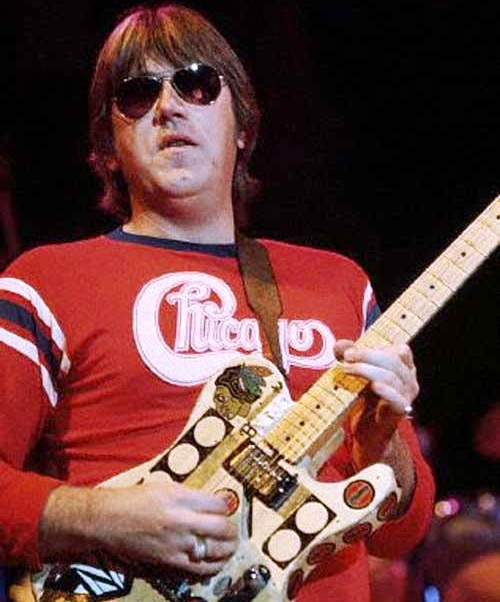
Chicago guitarist Terry Kath. Source: Getty Images
Terry Kath, a founding member of Chicago, was recognized for his Ray Charles-inspired baritone singing voice and innovative fretwork that earned the praise of Jimi Hendrix as “best guitarist in the universe.” Kath’s pioneering fuzz- and feedback-induced “Free Form Guitar,” off Chicago’s debut album (1969), was enough to prompt Eagles guitarist Joe Walsh to remark, “I had no idea how he was getting his guitar to sound like that.”
By the mid-1970s, Terry Kath’s abuse of drugs and alcohol was affecting his mental health. Ominously, he frequently carried around loaded guns. On the night of January 23, 1978, a very high Kath started spinning his .38 revolver around his finger and pointing it at his head. Reassuring his friends, Kath displayed an empty clip and inserted it into the gun. His last words were, “What do you think I’m going to do? Blow my brains out?”
Tragically, there was one round in the chamber. Kath pulled the trigger and died instantly. He was 31.
The following is a video clip of “25 or 6 to 4,” a guitar cover (Kath being deceased) using a Terry Kath Telecaster guitar, published by Geraci Studio Cuts via YouTube:
Playlist: Notable Rock Guitar Performances
Here, in no particular order, are 36 of my favorite rock guitar recordings. The lead guitarist is listed last: